
Corporate Insured Retirement Plan (CIRP)
The Corporate Insured Retirement Plan (CIRP) shows shareholders of Canadian-controlled private corporations (CCPCs) the benefits of protecting their corporation with permanent life insurance. It's also a financial strategy that provides additional tax-efficient retirement income.
 For more information, contact your dedicated individual insurance expert.
For more information, contact our Business development team - Insurance.
This is how a CIRP works:
- The policyowner, a Canadian-controlled private corporation, takes out a permanent life insurance policy with cash value.
- The policyowner pays the premiums or deposits, which generates cash value over time.
- After several years, when the shareholder decides to retire, the corporation that holds the policy borrows money in the form of a loan or line of credit from a financial institution and agrees to use the insurance policy as collateral.
- In the projections for this strategy, no payments are made on the loan principal or capitalized interest during the insured person's lifetime.
- Upon the death of the insured, the settlement process is as follows:
- The insurance amount is paid, tax-free, to the corporation.
- The loan taken out with the financial institution, including interest, is paid back during the settlement of the insurance policy.
- The excess insurance amount can be paid to the estate as a non-taxable dividend through the capital dividend account (this sum can't exceed the insurance amount minus the adjusted cost base (ACB) of the policy).
If there's a surplus, it will be paid to the estate through the ordinary dividend account, which is taxable.
The CIRP is designed for a specific context, where an owner or principal shareholder of a private corporation is looking for additional retirement income.
- The corporation is well-established and has significant taxable investments, and its income is higher than its operational costs.
- The corporation has taxable investments that can generate high passive income.
- The owner is confident that the corporation will continue to prosper and is looking to increase their retirement income in a tax-efficient way.
- The financial needs analysis reveals a significant life insurance need in order to protect the corporation in the event of the shareholder's death.
- The shareholder is in good health and eligible for permanent life insurance.
- The shareholder is generally age 30 to 55 and is still years away from retirement.
Eligible products
The CIRP is a flexible financial planning method that uses permanent life insurance to provide 3 essential benefits to business owners or shareholders:
- The insurance amount is not taxable in the event of death and provides liquidity to help cover some of the corporation's operating costs, ensure that payments are made to creditors and suppliers, and fund a buy-sell agreement.
- The corporation's taxes are reduced when it reallocates its investments into the permanent life insurance premiums.
- Policy cash values accumulated can be used while the insured is alive for business or investment purposes, including to increase their retirement income whether they're an owner or shareholder.
Our collateral financing agreements were specially designed for our guaranteed whole life, universal life and participating whole life insurance products, which all have cash values. Since the insurance amount on universal and participating whole life policies offers significant growth opportunities over time, these products are the best suited to clients' long-term needs.
Permanent life insurance
- Whole Life Guaranteed (10 Pay, 15 Pay, 20 Pay, to 65 or to 100)
Hybrid products Life with Critical Illness Advance and Life with Long-Term Care Advance are not eligible.
Participating whole life insurance
- 5 Pay PAR
- Accelerated Growth (10 Pay, 20 Pay or to 100)
- Estate Enhancer (10 Pay, 20 Pay or to 100)
Dividend option- Paid-up additions (PUAs)
With or without premium offset (except for 5 Pay PAR) - Enhanced insurance
Premium offset accepted where available.
- Paid-up additions (PUAs)
Types of eligible coverage
- Individual
- Joint first-to-die
- Joint last-to-die
- Joint last-to-die, paid-up first death
Benefits
There are many benefits to choosing life insurance through the CIRP strategy:
- It provides immediate liquidity to the corporation to meet financial obligations that arise when the shareholder dies. The amount payable upon death can grow significantly on a tax-efficient basis, providing permanent protection for the corporation.
- The policy's cash values increase with a tax deferral as long as it remains in the policy.
- The policy's cash values can be used during the shareholder's lifetime in a variety of ways, according to the corporation 's needs.
- It helps diversify the corporation's investments.
- The corporation's passive income can be reduced each year by using money available in the corporation's taxable investments to pay the insurance premiums. This can reduce the amount of taxes paid by the corporation during the shareholder's lifetime.
- Upon death, only the policy's cash value contributes to the corporation’s share value. This can reduce the capital gains tax payable on the value of the shareholder's shares.
- The corporation can access the cash value accumulated in the life insurance policy through other means, such as a policy loan or a partial withdrawal on the cash surrender value or total surrender of the policy. When the policyowner withdraws the cash surrender value, taxable income can be declared in the same year*.
- The CIRP strategy allows for the cash value to be used to secure a loan with no tax implications, unlike conventional methods to access cash value.
- Taking out a loan with insurance as collateral does not qualify as a contractual provision. The CIRP strategy allows for liquidity, up to a certain percentage of the policy's cash value, without tax implications.
- Note that this benefit applies provided the lending institution does not call in the line of credit or loan during the insured's lifetime. If the creditor calls in the loan before the insured's death, the consequences could be catastrophic.
*The policyowner should check with their tax advisor, as the tax implications of the different uses of corporation-owned life insurance during the insured's lifetime can vary.

To illustrate the effects of the CIRP strategy, we've compared it to an investment portfolio using the same amounts that would have been used to pay premiums or deposits for the insurance policy also held by the corporation.
The client has the choice of defining the components of an investment portfolio, the asset allocation and the estimated long-term rate of return for each asset class. Asset accumulation, tax and disposition rules are all simulated in this portfolio to assess what performs best over the years, between life insurance and investment.

With the CIRP strategy, you'll find the answer!
Using the CIRP strategy requires vigilance. Before opting for this strategy to eventually take out a loan, you need to make sure you understand how it works and the risks it involves, and that you properly explain it all to your clients.
Things to consider
- Under the federal Income Tax Act, a loan with a life insurance policy as collateral is not considered to be a disposition of an interest in the policy for tax purposes and therefore does not require tax reporting of the gains accrued in the policy. This means that the borrower will not have to pay tax on the amounts borrowed throughout the term of the loan. However, the tax treatment of loans with a life insurance policy as collateral may change before the loan is granted. As a general rule, these changes do not exempt the agreements in effect at the time of the change.
- The use of the policy's cash value as collateral for a loan to a third party is not guaranteed. The borrower must meet the requirements of the financial institution granting the loan. There may be conditions, fees and costs associated with the loan. The lending institution sets the loan limit and its structure, which can be a lump sum or installments, like a line of credit.
- Once a life insurance policy has been used as collateral, the corporation must obtain the financial institution's prior consent or repay the loan before exercising certain rights granted under the insurance policy, including policy loans, partial withdrawals, surrender and changes to the policy.
- The lending financial institution will determine a percentage of the insurance policy's cash value as the maximum amount that can be borrowed without additional collateral. Variations between the actual performance of the insurance policy and the performance described in the presentation of the CIRP will have an impact on the maximum loan amount granted and the collateral requirements.
- The interest rate on the loan is not guaranteed and may vary. If the interest rate is higher than the one indicated in the presentation, the loan-to-cash value ratio may exceed the financial institution's pre-determined maximum. Additional collateral may then be required.
- If the insured lives beyond the maximum age indicated in the presentation, the loan-to-cash value ratio may exceed the maximum set by the financial institution. Additional collateral may then be required.
- If the loan-to-cash value ratio exceeds the maximum set by the financial institution, it may require payments to reduce the loan balance or additional collateral. If the borrower is unable to meet these requirements, the financial institution may require an advance, a withdrawal or even the surrender of the insurance policy to repay the loan. This can result in a taxable gain for the policyowner and the corporation will have to include it in its tax return.
- If the corporation has taken out the life insurance to meet its retirement income obligations, tax authorities may consider it a retirement agreement, which could have considerable tax implications.
- Interest on a loan may be deductible if it's paid or payable on a borrowed sum used to generate income for a corporation, or to acquire an asset used to generate such income. If the loan proceeds are used as retirement income, this condition is not met.
- The life insurance policy's cash surrender values as outlined in the report are based on specific assumptions. Actual results may differ. Unless otherwise indicated, cash values are not guaranteed and vary over time, and this could affect the values shown in the presentation.
- Alternative investment projections are based on assumed interest rates that are not guaranteed and that may vary. Any changes in the assumed returns may affect the values indicated in the presentation.
- If a corporation has a cash value insurance policy, it could affect how corporation shares are valuated. The policy is a passive asset and may have an impact on the lifetime capital gains exemption. The policy’s value is based on the cash value just before death or on the assessment principles established by tax authorities.
- The CIRP presentation report is complete if it contains all the pages. It must be accompanied by the complete illustration of the appropriate life insurance product prepared in the 30 days following the date of the report, of which it's an integral part.
- Using this strategy does not guarantee that the requested insurance amount will be approved. The proposed insured must qualify under certain medical and financial requirements to benefit from insurance coverage after submitting an application.
- All comments regarding taxation are general and based on legislation and administrative policies published by tax authorities as of the date of the report, but do not cover every possible situation. Changes in tax legislation and administrative policies may affect the results. Therefore, tax treatment of the CIRP strategy and its results may change and are not guaranteed.
- Desjardins Insurance does not intend to provide legal, tax or accounting advice to current or prospective clients. The information contained in the report and illustration is not intended to provide such advice, nor is it to replace the advice of independent legal, tax and accounting professionals. Clients should refer to these professionals to get advice that's tailored to their situation.
To create the report to illustrate the CIRP strategy, you first need to enter the product features based on the following:
- The policyowner is the corporation.
- The proposed insured is a shareholder of the corporation.
- Do not add any additional coverage, since it's not taken into account when comparing amounts in the report.
This applies to the presentation and is not a constraint for selling additional coverage.
How to create the illustration
- Click on the Strategies tab.
- Open the Concepts section.
- In the Business Owners section, select Corporate Insured Retirement Plan.
- Click the Export button to download the illustration data to an Excel spreadsheet.
Open the downloaded file through your browser or in your Downloads folder.
You'll have 60 minutes to open the file and access the data in the illustration. After that, you'll have to download the spreadsheet again. - Enable content and macros when opening the spreadsheet.

- This screen will appear for the selected product.
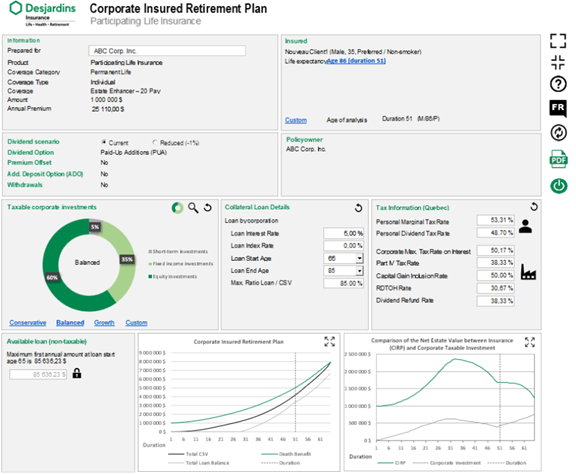
- Make sure the information about the proposed insured and the insurance coverage is correct.
If it isn't, exit the page and restart the illustration. - Confirm or change the name of the corporation the strategy is being prepared for.
- In the Insureds section, select the period of time you want to analyze.
Click the Personalize link to select the life expectancy of one of the proposed insureds, the equivalent age or any other period. The time selected is indicated on the charts by a dotted vertical line. - Create a hypothetical portfolio in the Taxable Investment section, allocating to interest, dividend and capital gain income.
The allocation must always add up to 100%.
For each type of investment, choose a rate of return that's realistic and takes the current situation into account. This investment portfolio for the corporation will be compared to the values of insurance policy. We assume that the amounts invested in both scenarios are the same. You can view the investment composition as a chart or a table, depending on your preference. - In the Collateral Loan Details section, enter the loan interest rate, the annual indexation rate (if desired) and the start and end dates of the shareholder's payments.
The maximum loan-to-cash value ratio is 85%. We do not recommend changing it. - The tax rates shown are in the calculations vary by province.
These rates are updated and do not need to be changed. - Once you've entered all the relevant information, the tool will calculate the maximum annual loan starting at the selected age. To reduce this amount, click the lock icon to unlock it. All the other parameters are set to match the initial assumptions.
If you click the lock icon again, the initial maximum values will reappear and the other variables can be changed as needed. - Two interactive charts will show how the results change based on the data you enter.
- The first shows the policy's cash value in relation to the accumulated loan (rate, term, indexation, etc.).
Note that the loan will never exceed your chosen loan-to-cash value ratio. - The second shows the net value that will go to the estate for the insurance with the CIRP strategy and the investment held by the corporation.
- The first shows the policy's cash value in relation to the accumulated loan (rate, term, indexation, etc.).
- Click the Display report button and it will open as a PDF.
- A copy of the report is automatically saved in the /Downloads/Desjardins.
You can also save it manually. - Go back to the Corporate Insured Retirement Plan input screen and click Exit.
You can only use the saved PDF copy of the report.
To present the strategy again, you'll need to create a new illustration and download it from the Strategies tab.