
FAQ - Participating whole life insurance
Update: May 2025
Understanding the products you sell is key to gaining your clients' trust. Here are answers to some frequently asked questions about participating life insurance.

For any other questions about this product, please contact our Business development team - Insurance..
For any other questions about this product, please contact your individual insurance expert.
Additional Deposit Option (ADO)
Yes. The shorter the payment period, the more limited the available tax room. In other words, a participating whole life to 100 policy offers more tax room than a 10 pay policy.
We recommend comparing multiple illustrations to give the right advice to the policyowner.
Yes, the same rate is used.
Yes, the permitted annual deposit amount is the same. However, the net deposit is lower because additional management fees are added for the extra premium.
This will have an impact on paid-up additions because these are purchased with the net deposit amount.
Yes. For example, a decrease in the insurance amount or a change in risk class (from smoker to non-smoker, for example) could reduce the maximum permitted deposit amount. You’ll see this if you create a new illustration.
On each policy anniversary, we use the paid-up additions (PUAs) purchased with deposits and the PUAs purchased with dividends to make up the enhanced insurance, until it consists entirely of PUAs.
Afterwards, the PUAs purchased with deposits and the PUAs purchased with dividends are added to the previous PUAs.
No, it won’t change the way ADO works.
The permitted annual deposits must be made during the first year of the policy. Since the issue date will be retroactive, the next policy anniversary date will be closer, leaving less time for the policyowner to make the permitted annual deposits in the first year.
New dividend scale
The current interest rate of 6.2% will increase to 6.3% on July 1, 2024. The new rate will remain in effect until June 30, 2025, and be revised each year thereafter on July 1.
Note about the State Farm participating backbook policies
The dividend scale interest rate will increase to 6% on July 1, 2024, for participating policies for the State Farm backbook policies.
The dividend scale interest rate increase and the revised mortality assumptions will mean higher dividends for most participating life insurance policies.
You should have access to an illustration with projected values based on the new dividend scale that you can show to policyowners. They will then be able to compare it with the last illustration they received.
Illustrations for Protector products and products in State Farm's in-force portfolio will be produced automatically and uploaded to Clients Documents.
For all other products, you will be able to email Expertise_Portefeuille_Backbook@dsf.ca to request new illustrations starting July 2, 2024.
No, there is no change to the maximum enhanced insurance amount.
Yes, this rate could go up or down, depending on economic conditions and the results of the dividend account.
Dividend option and premium offset
Yes. The policyowner can request this later, even if the premium offset was not shown initially in the sales illustration.
It is important to know that the premium offset is not guaranteed as it is dependent on the dividends paid. A decrease in the dividend scale interest rate may delay the beginning of the premium offset or require the policyowner to resume paying premiums.
Premium offset is not available with the 5-Pay PAR product.
No. All policy loans must be repaid before the premium offset takes effect. A new loan can be granted after the premium offset takes effect, but the offset will only apply to the premiums and not the policy loan (capital or interest).
Dividends that exceed the annual premium amount are paid to the policyholder by cheque. The refund generates a taxable policy gain if it is higher than the policy’s adjusted cost basis. The option is only available if the premium is paid annually.
The Annual premium reduction option uses the dividends paid each year to reduce the annual premium amount. If the dividends do not cover the full premium amount, the policyowner pays the difference. If the dividends are higher than the premium, the excess is paid to the policyowner by cheque. For this reason, the total amount payable at death does not increase over the years.
The Premium offset option is only available when annual dividends and the non-guaranteed surrender value are enough to cover future premiums. The total amount payable at death may increase if the Paid-up additions or Enhanced insurance options have been selected.
- For the Paid-up additions (PUAs) option, the basic amount is considered.
- For the Enhanced Insurance option, underwriters consider the total amount, i.e., the basic amount plus the enhanced amount.
The enhanced insurance guarantee is guaranteed for 10 years or life for Estate Enhancer and Accelerated Growth products. Depending on the chosen option, the enhanced amount is guaranteed for 10 years or life, even if the dividends are not high enough to cover the premium for the 1-year term insurance. For the 10-year option, the policyowner will have to pay an additional premium to maintain their initial insurance amount if the dividends are not high enough after 10 years.
The enhanced amount for the 5 Pay PAR product is guaranteed for life.
However, the enhanced insurance guarantee may be revoked regardless of the product chosen if the policyowner changes their insurance by:
- Withdrawing paid-up additions (PUAs) to receive the cash surrender value
- Converting their policy into reduced paid-up insurance
- Changing their dividend option
(for the 5 Pay PAR product, the change can be offered 10 years after the policy is purchased if the product remains tax-free) - Changing a risk class (for example, smoker to non-smoker)
- Switching to the premium offset option
Yes, it's possible to illustrate this switch to the dividend option as of the 10th year of the policy. However, this change doesn't automatically apply to the year of the change indicated in the initial illustration. The policyowner must submit the request in writing at the desired time, after 10 years.
Premium payments
The guaranteed minimum premium payment period varies according to the coverage selected:
- 5 years for 5 pay PAR product.
- 10 years for Estate Enhancer and Accelerated Growth products. However, it is possible to stop paying premiums more quickly thanks to the premium offset option. Note that the premium offset is not guaranteed.
Yes. This program automatically reduces premiums for insureds who have a rated premium due to their health or lifestyle.
This program applies to participating life insurance products and is available at issue and at conversion.
We offer an rated premium reduction of 30% to 80% depending on the product selected and the insured's age when the policy is issued. All insured persons are eligible, and no request is necessary. Your Illustration tool will automatically calculate the premium when you enter the rating determined by the underwriter.
See the rate reduction program page to find out the reduction percentages.
Yes. The policyowner can put a lump sum to be used for future premiums in a premium deposit account. The interest rate credited to this account is variable and the interest earned is taxable each year. See the Interest rates on premium deposit fund page for the current rate.
Cash surrender values
Yes. The amount payable at death is reduced to the basic amount, which then starts to grow. Surrendering PUAs could generate a taxable policy gain.
The policyowner can use their guaranteed or non-guaranteed cash surrender values in a number of ways. 5 options are available:
- Withdraw the non-guaranteed cash surrender value generated by the paid-up additions
- Apply for a policy loan
- Request a partial surrender of the basic insurance coverage
- Request for total surrender of the policy
- Ask for premium payments to be stopped and obtain the reduced paid-up insurance
The first 4 options could result in a taxable policy gain. See pages 37-41 of the Advisor Guide for more information on the tax treatment of each option.
Surrendering PUAs to pay life insurance premiums (excluding premiums used to pay for additional coverage in a policy issued before January 1, 2017) is considered to have no proceeds of disposition, and therefore does not generate a taxable policy gain. However, the life insurance premium amount paid by surrendering PUAs will not increase the policy’s adjusted cost basis.
Illustrations
Yes, this feature is available for participating life insurance.
However, the financial needs analysis (FNA) is essential in identifying required insurance coverage. You can use it to see the gap between your client's current situation and their actual insurance needs, and how to fill it. You can then recommend the right coverage for all their insurance needs based on their financial situation.
To use this feature:
- In the Calculation Basis dropdown menu, select Premium.
- Enter the premium amount in the Monthly Premium or Annual Premium field, according to the frequency selected in Summary View.
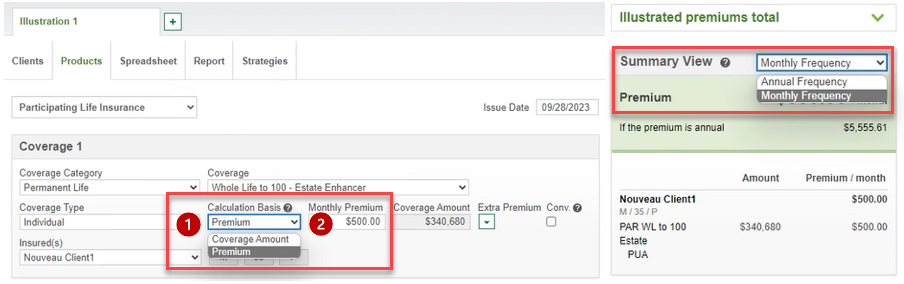
Details
The premium entered does not include the cost of the additional coverages selected. As needed to stick to the client's budget, you have to subtract the cost of any additional coverage selected.
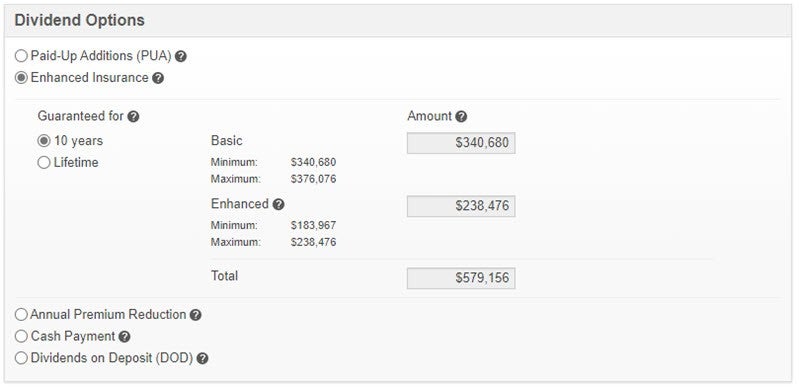
If the Enhanced Insurance dividend option is selected, the tool automatically calculates the enhanced amount. That means minimum and maximum amounts are determined for both Basic and Enhanced insurance. You cannot modify the Basic amount or the Total. However, you can choose the Guaranteed for amount (10 years or Lifetime, except for the 5 Pay PAR product, for which only the Lifetime option is available).
The regular rate still applies, and the premium stays the same.
No, the insured doesn’t have to contact the insurer because their premiums will not change, except in the following 2 cases:
- If the insured chooses the Enhanced Insurance dividend option and plans to convert the 1-year term insurance portion into permanent life insurance, the conversion will be made at the regular rate.
- If the insured has bought the insurability option and exercises it after the age of 18, the option will be applied at the regular rate and at the attained age. In both situations, it is beneficial to contact the insurer as soon as the insured turns 18 to switch from the regular rate to the preferred rate.
Yes. Click on the Export to Excel button and the illustration tool will export the results. Once exported, the results for each scenario are displayed in a different tab in the Excel file. The results of the reduced scenario (-1%) are in the second tab of the Excel file and those for the alternate rate scenario (at your choice: 2%, -1.5%, -0.5% et +0.5%) are in the third.
Yes. The rates of return are shown in the Results tab or in the illustration report when additional columns are added using the Customized Projection option.
The illustration tool can produce scenarios with an extra premium as a percentage. Extra flat dollars per thousand premiums will be evaluated case by case and can be illustrated by the head office.
For joint coverage, an equivalent extra premium (as a % or as $/1,000) must be used.
No, because our tool only compares premiums. When we compare participating whole life insurance products, we should also compare the guaranteed and non-guaranteed surrender values, as well as the total amounts payable at death. For these reasons we decided not to include participating whole life insurance products in the Price Comparison tool. However, you can compare the premiums using Summary view by using the Compare function at the top right of the Illustration tool.
General
Here are the eligibility criteria for converting a term product into participating whole life insurance with the following options:
| Paid-up Additions (PUAs) and Enhanced Insurance Annual | Premium reduction, Cash payment and Dividends on deposit |
|---|---|
|
|
Once the policy is eligible for conversion to a permanent product and if the permanent product does not have any special clauses, the criteria above apply. However, some very old policies have restrictions or special clauses that do not allow conversion. It is important to handle such situations case by case to avoid misleading the client. For verification, contact the Client relations centre with the policy number.