
How it works
- Features / Commission
- Returns calculation
- Tax treatment
- Surrender
- Videos
Features/Commission
Key features
- Guaranteed minimum return or principal guaranteed at maturity
- Risk-free access to securities of well-established companies
- Higher return potential than fixed-interest term investments
- No portfolio management and no management fees
- 100% death benefit guarantee
- Can be surrendered at any time, from the initial date of the campaign1
- Minimum deposit of $5002
- Deposits accepted until the age of 95 years less a day
- Eligible for registered plans3, including TFSAs
- Eligible for pension income tax credits
- Eligible for income splitting
- Protected by Assuris
(1) Deposits being held in the special daily interest investment and designated for Guarantee Advantage cannot be surrendered before the Initial Date. Also, the surrender value cannot be greater than the current value or the amount of the initial deposit. A market value adjustment charge may apply.
(2)All deposits are initially placed in a special daily interest investment until the next issue date. The sum accumulated on that date, called the initial date, constitutes the initial deposit and will be invested in Guarantee Advantage. If the investor chooses to set up a pre-authorized debit agreement, the term may be longer and the maturity date may occur later than initially stated, depending on the initial date.
(3) RRIFs and LIFs are not eligible for periodic payments. If such payments have to be made and only a variable investment is available, the investment must be totally or partially surrendered. For more information please refer to the Term Investments Contract.
Commission
The commission is paid at the time the deposits are invested in the special daily interest investment:
- For the term of 2 year and 2 days, the commission is 0.8%
- For the term of 3 year and 2 days, the commission is 1.2%
- For the term of 4 year and 2 days, the commission is 1.6%
- For the term of 5 year and 2 days, the commission is 2.0%
- For the term of 6 year and 2 days, the commission is 2.4%
- For the term of 7 year and 2 days, the commission is 2.8%
- No trailer fees
Returns calculation - example
Here is one example of how returns are calculated on the maturity date of a Guarantee Advantage campaign. For the purpose of this simulation, we have used a deposit of $10,000 in the Consumer staples campaign of August 10, 2017.
Calculation of returns on a $10,000 Deposit Range of returns: Minimum return: 2%, Maximum return: 15%
| Security | Opening price of security (CP1) | Average price of security for the 3 specific business days (CP2)1 | Cumulative return |
|---|---|---|---|
| Unilever PLC | 100 | 115 | 1.15 |
| Procter and Gamble | 100 | 142 | 1.42 |
| Nestlé | 100 | 90 | 0.90 |
| General Mills Inc. | 100 | 106 | 1.06 |
| Kimberly-Clark Corporation | 100 | 109 | 1.09 |
| Reckitt Benckiser Group PLC | 100 | 110 | 1.10 |
| The Coca-Cola Company | 100 | 111 | 1.11 |
| Danone SA | 100 | 124 | 1.24 |
| The Hershey Company | 100 | 132 | 1.32 |
| L'Oréal SA | 100 | 102 | 1.02 |
Average for the 10 securities: 1.141
Cumulative return: 14.10%
Compound annual return: 2.67%
Interest before issue2: $10,000 X (1 + ((1.00% ÷ 365) x 40)) = $10,010.96
Amount paid to the client at maturity:
$10,010.96 X 1.141 = $11,422.50
- Initial deposit = $10,000.00
= Total return at maturity = $1,422.50
1 For the campaign of August 10, 2017, the specific business days are: June 10, 2022, July 11, 2022 and August 10, 2022.
2 The daily interest paid prior to the initial date for the August 10, 2017 issue is 1.0%.
The simulation is based on the following assumptions: Deposit of $10,000 on July 1, 2017 in the Consumer staples campaign of August 10, 2017 with a term of 5 years and 2 days. The simulation is not an indication or a guarantee of future performance.
Calculation method
Guarantee Advantage has an effective way of dealing with the effects of market fluctuations: by using specific Business Days. Instead of using the price of the securities on the campaign’s maturity date only, we use the securities’ average price on three specific Business Days to determine returns.
In the preceding example, at maturity, since the cumulative growth falls within the campaign’s minimum and maximum returns, the actual return of the basket of securities is used. The actual return is equal to the average of the cumulative returns of each security in the basket. All of the securities have the same weighting in the portfolio.
- Specific Business Days
- For each issue, three specific Business Days within the last three months of the term are used to determine the final price.
Tax Treatment
In a non-registered Contract, the tax treatment of Guarantee Advantage lets your clients defer the taxation of the income on their Contract for a few years, even beyond the Deposit Maturity Date1. Plus, the accrued income on the product is eligible for pension income tax credits!2.
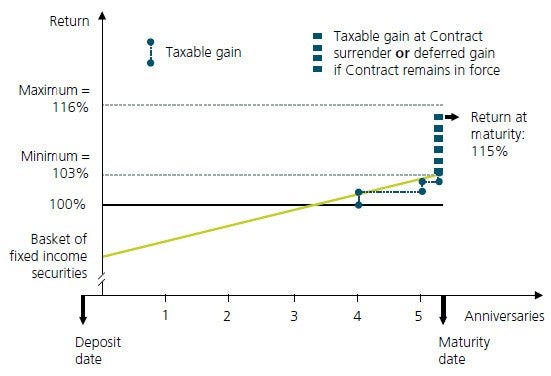
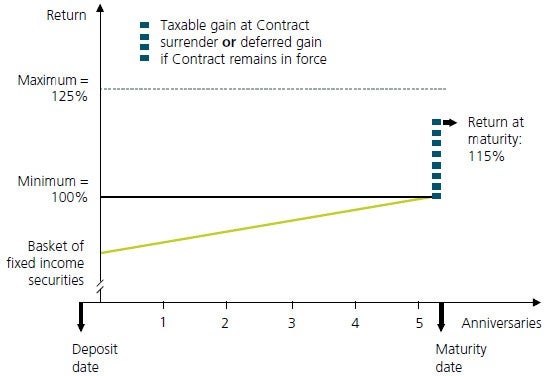
Tax treatment of Guarantee Advantage – 5-year term
Tax treatment when minimum return is greater than 0%
Tax treatment when minimum return is 0%
Before the deposit matures
Guarantee Advantage is taxed annually on the Contract's anniversary date. On all Contract anniversary dates, the taxable income is calculated based on the “accumulation fund”. This fund is equal to either the Surrender Value3 or the Current Value of the minimum guarantee as determined by Desjardins Insurance (value of the basket of fixed income securities), whichever is greater. The tax is generally nil in the first few years of the term, when Guarantee Advantage’s minimum return is greater than 0%. The tax is nil before maturity, when Guarantee Advantage’s minimum return is equal to 0%.
At the deposit maturity date, your clients have two options:
- Redeem their Contract: They will be taxed on the gains that exceed the value already taxed during the term.
- Reinvest: Taxation in the year including the next anniversary date of the Contract .
Example
- Deposit of $1,000 in GA Financials - 5 years, March 1, 2015
- Maturity date: April 10, 2020
- Value at maturity: $1,150
The tax treatment at maturity will be different depending on whether the client surrenders the Contract or decides to reinvest.
- Contract surrender
- The client has chosen option 3-16 (minimum return greater than 0%)
- The client has chosen option 0-25 (minimum return of 0%)
- Reinvestment in the Contract
- The client has chosen option 3-16 (minimum return greater than 0%)
- The client has chosen option 0-25 (minimum return of 0%)
The client will be taxed each year from the time the value of the basket of fixed income securities is greater than the value of the Initial Deposit.
| Year | Taxable gain |
|---|---|
| 2016 | 0 |
| 2017 | 0 |
| 2018 | 0 |
| 2019 | 8 |
| 2020 | 20 |
| Total | 28 |
Total taxable gain4: $150 ($1,150 – $1,000)
As the client has already been taxed on $28, he or she will be taxed only on the remaining $122 at maturity, in April 2020. As the client will be surrendering the Contract at that time, the $142 ($122 + $20) will be taxable in 2020.
The client will not be taxed during the term because the value of the basket of fixed income securities will never exceed the value of the Initial Deposit.
There will be a taxable gain of $150 at maturity, in April 2020, because the client will be surrendering the Contract at that time.
The annual taxation will remain the same throughout the term.
The client will be taxed each year from the time the value of the accumulated fund is greater than the value of the Initial Deposit.
| Year | Taxable gain |
|---|---|
| 2016 | 0 |
| 2017 | 0 |
| 2018 | 0 |
| 2019 | 8 |
| 2020 | 20 |
| Total | 28 |
Total taxable gain: $150 ($1,150 – $1,000)
As the client has already been taxed on $28, he or she will be taxed only on the remaining $122. The gain will be taxed the year in which the next anniversary date of the Contract occurs5, that is, in 2021.
The client won’t be taxed during the term because the value of the basket of fixed income securities will never exceed the value of the Initial Deposit.
There will be a taxable gain of $150 at maturity in April 2020. This policy gain will be taxed the year in which the next anniversary date of the Contract occurs5, that is, in 2021.
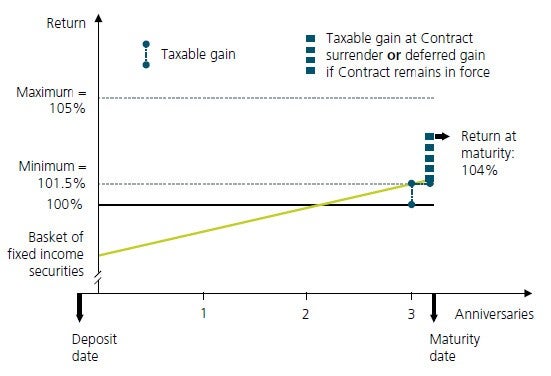
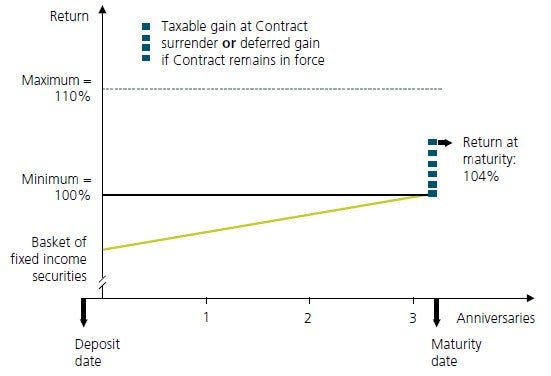
Tax treatment of Guarantee Advantage – 3-year term
Tax treatment when minimum return is greater than 0%
Tax treatment when minimum return is 0%
Before the deposit matures
Guarantee Advantage is taxed annually on the Contract's anniversary date. On all Contract anniversary dates, the taxable income is calculated based on the “accumulation fund”. This fund is equal to either the Surrender Value6 or the Current Value of the minimum guarantee as determined by Desjardins Insurance (value of the basket of fixed income securities), whichever is greater. The tax is generally nil in the first few years of the term, when Guarantee Advantage’s minimum return is greater than 0%. The tax is nil before maturity, when Guarantee Advantage’s minimum return is equal to 0%.
At the deposit maturity date, your clients have two options:
- Redeem their Contract: They will be taxed on the gains that exceed the value already taxed during the term.
- Reinvest: Taxation in the year including the next anniversary date of the Contract.
Example
- Deposit of $1,000 in GA Financials - 3 years, March 12, 2015
- Maturity date: April 10, 2018
- Value at maturity: $1,040
The tax treatment at maturity will be different depending on whether the client surrenders the Contract or decides to reinvest.
- Contract surrender
- The client has chosen option 1.5-5.5 (minimum return greater than 0%)
- The client has chosen option 0-10 (minimum return of 0%)
- Reinvestment in the Contract
- The client has chosen option 1.5-5.5 (minimum return greater than 0%)
- The client has chosen option 0-10 (minimum return of 0%)
The client will be taxed each year from the time the value of the basket of fixed income securities is greater than the value of the Initial Deposit.
Total taxable gain7: $40 ($1,040 – $1,000)
As the client has already been taxed on $14, he or she will be taxed only on the remaining $26 at maturity, in April 2018. Since the client will be surrendering the Contract at that time, the taxable amount in 2018 will be $40 ($26 + $14).
The client won’t be taxed during the term because the value of the basket of fixed income securities will never exceed the value of the Initial Deposit.
There will be a taxable gain of $40 at maturity, in April 2018, because the client will be surrendering the Contract at that time.
The annual taxation remains the same throughout the term.
The client will be taxed each year from the time the value of the basket of fixed income securities is greater than the value of the Initial Deposit.
| Year | Taxable gain |
|---|---|
| 2016 | 0 |
| 2017 | 0 |
| 2018 | 14 |
| Total | 14 |
Total taxable gain: $40 ($1,040 – $1,000)
As the client has already been taxed on $14, he or she will be taxed only on the remaining $26. This policy gain will be taxed the year in which the next anniversary date of the Contract occurs8, that is, in 2019.
The client won’t be taxed during the term because the value of the basket of fixed income securities will never exceed the value of the Initial Deposit.
There will be a taxable gain of $40 at maturity, in April 2018. This policy gain will be taxed the year in which the next anniversary date of the Contract occurs8, that is, in 2019.
1 Clients should always keep an Investment Option in force in the Contract. That way, they’ll maximize the benefits of Guarantee Advantage’s tax treatment. Term investments (including the Daily Interest Fund) and market-linked term investments are offered through the Desjardins Financial Security Life Assurance Company Term Investments Contract.
2 Conditions apply. At the federal level, the person must be over 65 before the end of the taxation year to be allowed to include Guarantee Advantage's income in the credit calculation. The gain generated at the Contract's surrender (partial or total) is not eligible for pension income tax credits.
3, 6 The Surrender Value of Guarantee Advantage before maturity cannot be greater than the value of the Initial Deposit.
4, 7 To make things simpler, we are using the expression “taxable gain” to describe the income earned over the term of the Contract, which is taxable under subsection 12.2(1) of the Income Tax Act, and the gain on the Contract’s surrender, which is taxable under subsection148(1) of this Act. The difference between these two types of income can be important for the purpose of certain deductions or certain tax credits. However, they are both fully taxable because they are not considered to be capital gains.
5, 8 Please note that if the client deposited in an existing Contract, the anniversary date of the Contract will not be the anniversary date of the Deposit in Guarantee Advantage but the anniversary date of the first Deposit in the Contract.
Surrender
Partial and total surrenders are possible with Guarantee Advantage. The Surrender Value is equal to the Current Value minus a Market Value Adjustment. The Surrender Value cannot be greater than the Current Value or the amount of the Initial Deposit.
Deposits being held in the special daily interest investment and designated for Guarantee Advantage cannot be surrendered before the initial date.
The Surrender Value is calculated as follows:
Example of a partial surrender one year after a Deposit in the February 14, 2014 campaign, which has a term of 5 years and 2 days:
February 14, 2014: Initial Deposit of $10,000
February 14, 2015: Current Value of $10,958 after one year
Partial surrender: $2,000
Number of years to maturity remaining: 4 years
Now let’s see how the partial surrender affects the guaranteed value and Current Value:
1. Surrender Value based on the rate of a 4-year GIC at 1.3%
Surrender value = [1 – (1.3% + 1.5%) x 4 years] x $10,958 = $9,730.70
2. Adjustment of the value guaranteed at maturity and death
Prorated adjustment of the surrender value =
$10,000 x (1 – $2,000 / $9,730.70) = $7,944.65
3. New Current Value
Initial Deposit adjusted based on the accumulated growth until surrender date =
$7,944.65x ($10,958 / $10,000) = $8,705.75
Videos
A three-part training on how Guarantee Advantage is structured.
Part 1: All About Call Options
Call options are central to how the return zone works. Find out how they help your clients benefit from the market’s potential without being directly exposed to its risks.

Part 2: How is the New Money in Guarantee Advantage Invested?
Learn more about all of the financial instruments that make up Guarantee Advantage and how they work.

Part 3: Let's See How it Works
This video uses concrete examples to show you how Desjardins Insurance uses call options to deliver on its advertised rates, every time, no matter what the market conditions are.